What might a ‘theory of everything’ look like? Is science an ideology? Who were Adorno, Horkheimer or the Frankfurt School? The decades since the 1960s have seen an explosion in the production of critical theories. Deconstructionists, poststructuralists, postmodernists, second-wave feminists, new historicists, cultural materialists, postcolonialists, black critics and queer theorists, among a host of others, all vie for our attention. Stuart Sim and Borin Van Loon’s incisive graphic guide provides a route through the tangled jungle of competing ideas and provides an essential historical context, situating these theories within tradition of critical analysis going back to the rise of Marxism. They present the essential methods and objectives of each theoretical school in an incisive and accessible manner, and pay special attention to recurrent themes and concerns that have preoccupied a century of critical theoretical activity.

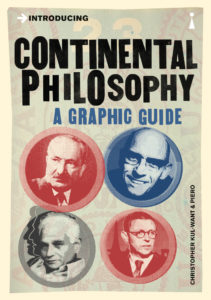
What makes philosophy on the continent of Europe so different and exciting? And why does it have such a reputation for being ‘difficult’? Continental philosophy was initiated amid the revolutionary ferment of the 18th century, philosophers such as Kant and Hegel confronting the extremism of the time with theories that challenged the very formation of individual and social consciousness. Covering the great philosophers of the modern and postmodern eras – from Nietzsche, Heidegger, Derrida and Deleuze right to up Agamben and Žižek – and philosophical movements from German idealism to deconstruction and feminism – Christopher Kul-Want and Piero brilliantly elucidate some of the most thrilling and powerful ideas ever to have been discussed.
‘An excellent book’ – Ted Honderich, Emeritus Professor of Philosophy of Mind and Logic at University College London (UCL)
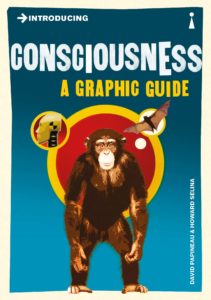
Introducing Consciousness provides a comprehensive guide to the current state of consciousness studies. It starts with the history of the philosophical relation between mind and matter, and proceeds to scientific attempts to explain consciousness in terms of neural mechanisms, cerebral computation and quantum mechanics. Along the way, readers will be introduced to zombies and Chinese Rooms, ghosts in machines and Erwin Schrodinger’s cat.
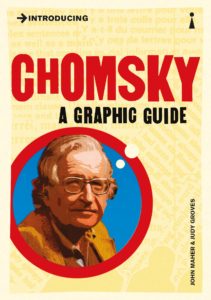
Can it be that the human brain possesses an in-built faculty for language? Noam Chomsky, one of the most brilliant linguists of the 20th century, believes that it does- that there exists a ‘universal grammar’ common to all languages. Around the world children learn, in very similar ways, languages that seem entirely different. This is possible, Chomsky argues, because all human languages and their grammatical structures are linked in the human brain. Chomsky is controversial and yet highly influential, both in his pioneering work in linguistics and in his unrelenting critique of international power and his commitment to freedom and justice. These two ‘Chomskys’ are heirs to the Enlightenment tradition, and this book is the ideal introduction to them both.
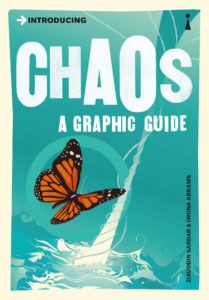
If a butterfly flaps its wings in Brazil, does it cause a tornado in Texas?
Chaos theory attempts to answer such baffling questions. The discovery of randomness in apparently predictable physical systems has evolved into a science that declares the universe to be far more unpredictable than we have ever imagined.
Introducing Chaos explains how chaos makes its presence felt in events from the fluctuation of animal populations to the ups and downs of the stock market. It also examines the roots of chaos in modern maths and physics, and explores the relationship between chaos and complexity, the unifying theory which suggests that all complex systems evolve from a few simple rules.
This is an accessible introduction to an astonishing and controversial theory.
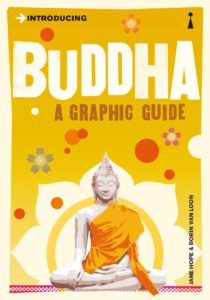
Meditation, Karma, Zen, Tantric and Nirvana are some of the many Buddhist ideas Westerners hear of frequently, even if their meaning has been lost in translation. This vast and complex non-theistic religion is woven into the fabric of Asian civilisations. from India to the Himalayan regions, China, Vietnam, Korea, Japan and elsewhere. What is Buddhism really all about? Introducing Buddha describes the life and teachings of the Buddha, but it also shows that enlightenment is a matter of experiencing the truth individually, and by inspiration which is passed from teacher to student. Superbly illustrated by Borin Van Loon, the book illuminates this process through a rich legacy of stories, explains the practices of meditation, Taoism and Zen, and goes on to describe the role of Buddhism in modern Asia and its growing influence on Western thought.
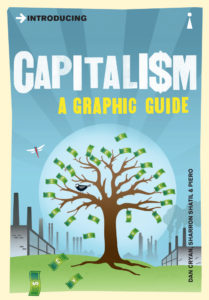
Capitalism now dominates the globe, both in economics and ideology, shapes every aspect of our world and influences everything from laws, wars and government to interpersonal relationships. Introducing Capitalism tells the story of its remarkable and often ruthless rise, evolving through strife and struggle as much as innovation and enterprise.
Dan Cryan and Sharron Shatil, with Piero’s brilliant graphics, cover the major economic, social and political developments that shaped the world we live in, such as the rise of banking, the founding of America and the Opium Wars.The book explores the leading views for and against, including thinkers like Adam Smith, Karl Marx, Theodor Adorno and Milton Friedman, the connections between them and their historical context.
Few ideas have had as much impact on our everyday lives as capitalism. Introducing Capitalism is the essential companion.
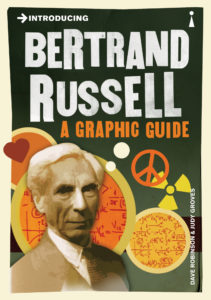
Bertrand Russell changed Western philosophy forever. He tackled many puzzles–how our minds work, how we experience the world, and what the true nature of meaning is. In “Introducing Bertrand Russell “we meet a passionate eccentric, active in world politics, who had outspoken views on sex, marriage, religion, and education.
Illustrated guide to the controversial sociologist Jean Baudrillard, who died in 2007. Did the Gulf War take place? Is it possible to fake a bank robbery? Was sexual liberation a disaster? Jean Baudrillard has been hailed as one of France’s most subtle and powerful theorists. But his provocative style and assaults on sociology, feminism and Marxism have exposed him to accusations of promoting a dangerous new orthodoxy – of being the ‘pimp’ of postmodernism. Introducing Baudrillard cuts beneath the controversy of this misunderstood intellectual to present his radical claims that reality has been replaced by a simulated world of images and events ranging from TV news to Disneyland. It provides a clear account of Baudrillard’s work on obesity, pornography and terrorism and traces his development from critic of mass consumption to prophet of the apocalypse. Chris Horrocks’ text and Zoran Jevtic?s artwork invite us to decide whether Baudrillard was a cure for the vertigo of contemporary culture – or one of its symptoms
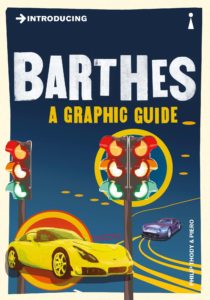
INTRODUCING guide to the cult author, semiologist and analyzer of advertising, Roland Barthes. Roland Barthes is best known as a semiologist, a student of the science of signs. This sees human beings primarily as communicating animals, and looks at the way they use language, clothes, gestures, hair styles, visual images, shapes and colour to convey to one another their tastes, their emotions, their ideal self-image and the values of their society. Introducing Barthes brilliantly elucidates Barthes’ application of these ideas to literature, popular culture, clothes and fashion, and explains why his thinking in this area made him a key figure in the structuralist movement of the 1960s. It goes on to describe how his later insistence on pleasure, the delights of sexual non-conformity, and the freedom of the reader to interpret literary texts in the light of ideologies such as existentialism, Marxism and Freudianism, as well as structuralism itself, continues to make him one of the most dynamic and challenging of modern writers. This is the perfect companion volume to Introducing Semiotics.