
Can it be that the human brain possesses an in-built faculty for language? Noam Chomsky, one of the most brilliant linguists of the 20th century, believes that it does- that there exists a ‘universal grammar’ common to all languages. Around the world children learn, in very similar ways, languages that seem entirely different. This is possible, Chomsky argues, because all human languages and their grammatical structures are linked in the human brain. Chomsky is controversial and yet highly influential, both in his pioneering work in linguistics and in his unrelenting critique of international power and his commitment to freedom and justice. These two ‘Chomskys’ are heirs to the Enlightenment tradition, and this book is the ideal introduction to them both.
Introducing Business Creativity US Edition
Introducing Business Creativity: A Practical Guide provides innovative techniques and proven theories to help you improve your creative thinking and get more out of yourself and your business. Whether you are trying to develop entirely new initiatives or redesign the way you operate, this book will help you break out of your old patterns of thought, think outside the box and generate pioneering ideas that you can put into action. Introducing Practical Guides bring you the world’s greatest theories and research to improve your life, your skills and your well-being. Packed full of straightforward, realistic advice that has immediate results, Practical Guides are engineered by experts in their fields to help you achieve your goals.
Introducing Infinity

Infinity is a profoundly counter-intuitive and brain-twisting subject that has inspired some great thinkers – and provoked and shocked others. The ancient Greeks were so horrified by the implications of an endless number that they drowned the man who gave away the secret. And a German mathematician was driven mad by the repercussions of his discovery of transfinite numbers.
Brian Clegg and Oliver Pugh’s brilliant graphic tour of infinity features a cast of characters ranging from Archimedes and Pythagoras to al-Khwarizmi, Fibonacci, Galileo, Newton, Leibniz, Cantor, Venn, Gödel and Mandelbrot, and shows how infinity has challenged the finest minds of science and mathematics. Prepare to enter a world of paradox. BOOKSONIX
Sexuality
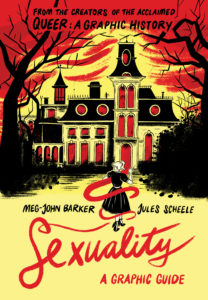
Sexuality delivers the goods, making the history and theory of sexuality downright sexy … I learned more in one session with this book than I’ve figured out in a lifetime.’ Christine Burns MBE, author of Trans Britain
They’re back! Writer Meg-John Barker and artist Jules Scheele once again team up in this cheeky and informative comic-book follow-up to Queer and Gender.
Sex is everywhere. It’s in the stories we love – and the stories we fear. It defines who we are and our place in society … at least we’re told it ought to.
Sex and sexuality can seem like a house of horrors, full of monsters and potential pitfalls. We often live with fear, shame and frustration when it comes to our own sexuality, and with judgement when it comes to others’. Sex advice manuals, debates over sex work and stories of sexual “dysfunction” only add to our anxiety.
With compassion, humour, erudition and a touch of the erotic, Meg-John Barker and Jules Scheele shine a light through the darkness and unmask the monsters.
‘The art introduces a set of reoccurring characters, tongue-in-cheek references to the Scooby-Doo gang, who journey through a haunted house confronting and unmasking the villains: patriarchy, white supremacy, ableism, and capitalism personified … The sum: accessible, compassionate reading for readers wanting to think more deeply about sex, society, and how they intersect.’ Publishers Weekly
Sexuality
Sexuality delivers the goods, making the history and theory of sexuality downright sexy … I learned more in one session with this book than I’ve figured out in a lifetime.’ Christine Burns MBE, author of Trans Britain
They’re back! Writer Meg-John Barker and artist Jules Scheele once again team up in this cheeky and informative comic-book follow-up to Queer and Gender.
Sex is everywhere. It’s in the stories we love – and the stories we fear. It defines who we are and our place in society … at least we’re told it ought to.
Sex and sexuality can seem like a house of horrors, full of monsters and potential pitfalls. We often live with fear, shame and frustration when it comes to our own sexuality, and with judgement when it comes to others’. Sex advice manuals, debates over sex work and stories of sexual “dysfunction” only add to our anxiety.
With compassion, humour, erudition and a touch of the erotic, Meg-John Barker and Jules Scheele shine a light through the darkness and unmask the monsters.
‘The art introduces a set of reoccurring characters, tongue-in-cheek references to the Scooby-Doo gang, who journey through a haunted house confronting and unmasking the villains: patriarchy, white supremacy, ableism, and capitalism personified … The sum: accessible, compassionate reading for readers wanting to think more deeply about sex, society, and how they intersect.’ Publishers Weekly
Introducing Foucault
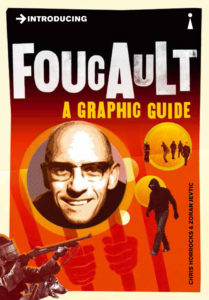
Michel Foucault’s work was described at his death as ‘the most important event of thought in our century’. As a philosopher, historian and political activist, he certainly left behind an enduring and influential body of work, but is this acclaim justified? “Introducing Foucault” places his work in its turbulent philosophical and political context, and critically explores his mission to expose the links between knowledge and power in the human sciences, their discourses and institutions. This book explains how Foucault overturned our assumptions about the experience and perception of madness, sexuality and criminality, and the often brutal social practices of confinement, confession and discipline. It also describes Foucault’s engagement with psychiatry and clinical medicine, his political activism and the transgressive aspects of pleasure and desire that he promoted in his writing.
Queer: A Graphic History
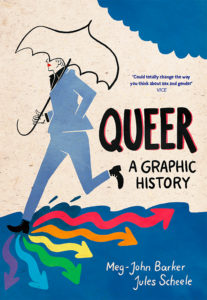
‘Queer: A Graphic History Could Totally Change the Way You Think About Sex and Gender’ Vice
Activist-academic Meg-John Barker and cartoonist Jules Scheele illuminate the histories of queer thought and LGBTQ+ action in this groundbreaking non-fiction graphic novel.
From identity politics and gender roles to privilege and exclusion, Queer explores how we came to view sex, gender and sexuality in the ways that we do; how these ideas get tangled up with our culture and our understanding of biology, psychology and sexology; and how these views have been disputed and challenged.
Along the way we look at key landmarks which shift our perspective of what’s ‘normal’ – Alfred Kinsey’s view of sexuality as a spectrum, Judith Butler’s view of gendered behaviour as a performance, the play Wicked, or moments in Casino Royale when we’re invited to view James Bond with the kind of desiring gaze usually directed at female bodies in mainstream media.
Presented in a brilliantly engaging and witty style, this is a unique portrait of the universe of queer thinking.
Marxism: A Graphic Guide
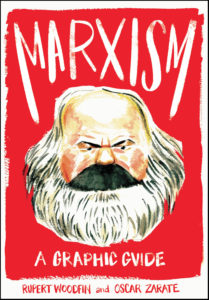
Beautiful new edition of a classic comic-book introduction to Marxist thought.
Karl Marx was one of the most influential thinkers of the late 19th century, inspiring revolutions and colossal political upheavals that have radically transformed the lives of millions of people and the geopolitical map of the entire world.
But was he a ‘Marxist’ himself? And how are his ideas still in play in today’s society?
Marxism: A Graphic Guide traces the story of Marx’s original philosophy, from its roots in 19th-century European thinkers like Hegel, to its influence on modern-day culture. It looks at Marxism’s Russian disciples, Lenin, Trotsky and Stalin, who forged a ruthless, dogmatic Communism, and the alternative Marxist approaches of Gramsci, the Frankfurt School of critical theory and the structuralist Marxism of Althusser in the 1960s.
Rupert Woodfin and Oscar Zarate’s classic book, updated by Alex Locascio, explores the life, history, philosophy and politics of this most divisive of thinkers, and argues that Marxism remains a powerful set of ideas even today.
Introducing Wittgenstein

This is a superlative graphic guide described as ‘warm, witty and wise’ by Jonathan Ree to an enigmatic master of twentieth-century philosophy.
Introducing Walter Benjamin
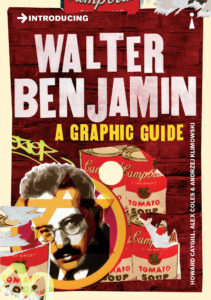
Walter Benjamin is often considered the key modern philosopher and critic of modern art. Tracing his influence on modern aesthetics and cultural history, Introducing Walter Benjamin highlights his commitment to political transformation of the arts as a means to bring about social change. Benjamin witnessed first-hand many of the cataclysmic events of modern European history. He took a critical stance on the dominant ideologies of Marxism, Zionism and Technocracy, and his attempt to flee Nazi Europe ultimately led to his suicide in 1940. With its brilliant combination of words and images, this is an ideal introduction to one of the most elusive philosophers.