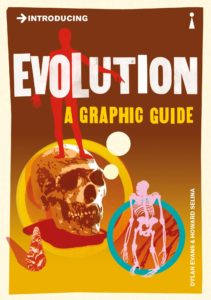
How did the mind evolve? How does the human mind differ from the minds of our ancestors, and from the minds of our nearest relatives, the apes? What are the universal features of the human mind, and why are they designed the way they are? If our minds are built by selfish genes, why are we so cooperative? Can the differences between male and female psychology be explained in evolutionary terms? These questions are at the centre of a rapidly growing research programme called evolutionary psychology.

In 1859, Charles Darwin shocked the world with a radical theory – evolution by natural selection. One hundred and fifty years later, his theory still challenges some of our most precious beliefs. Introducing Evolution provides a step-by-step guide to ‘Darwin’s dangerous idea’ and takes a fresh look at the often misunderstood concepts of natural selection and the selfish gene. Drawing on the latest findings from genetics, ecology and animal behaviour- as well as the work of best-selling science writers such as Richard Dawkins and Steven Pinker- this book reveals how the evidence in favour of evolutionary theory is stronger than ever.
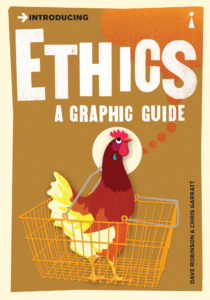
What is the place of individual choice and consequence in a post-Holocaust world of continuing genocidal ethnic cleansing? Is “identity” now a last-ditch cultural defence of ethnic nationalisms and competing fundamentalisms? In a climate of instant information, free markets and possible ecological disaster, how do we define “rights”, self-interest and civic duties? What are the acceptable limits of scientific investigation and genetic engineering, the rights and wrongs of animal rights, euthanasia and civil disobedience?”Introducing Ethics” confronts these dilemmas, tracing the arguments of the great moral thinkers, including Socrates, Plato, Aristotle, Hobbes and Kant, and brings us up to date with postmodern critics.
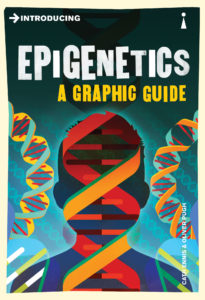
Epigenetics is the most exciting field in biology today, developing our understanding of how and why we inherit certain traits, develop diseases and age, and evolve as a species.
This non-fiction comic book introduces us to genetics, cell biology and the fascinating science of epigenetics, which is rapidly filling in the gaps in our knowledge, allowing us to make huge advances in medicine. We’ll look at what identical twins can teach us about the epigenetic effects of our environment and experiences, why certain genes are ‘switched on’ or off at various stages of embryonic development, and how scientists have reversed the specialization of cells to clone frogs from a single gut cell.
In Introducing Epigenetics, Cath Ennis and Oliver Pugh pull apart the double helix, examining how the epigenetic building blocks and messengers that interpret and edit our genes help to make us, well, us.
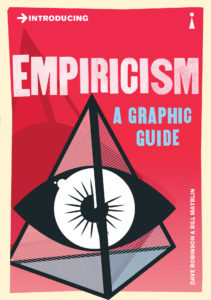
Our knowledge comes primarily from experience – what our senses tell us. But is experience really what it seems?
The experimental breakthroughs in 17th-century science of Kepler, Galileo and Newton informed the great British empiricist tradition, which accepts a ‘common-sense’ view of the world – and yet concludes that all we can ever know are ‘ideas’.
In Introducing Empiricism: A Graphic Guide, Dave Robinson – with the aid of Bill Mayblin’s brilliant illustrations – outlines the arguments of Locke, Berkeley, Hume, J.S. Mill, Bertrand Russell and the last British empiricist, A.J. Ayer. They also explore criticisms of empiricism in the work of Kant, Wittgenstein, Karl Popper and others, providing a unique overview of this compelling area of philosophy.
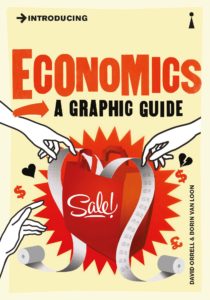
A comic-book introduction to economics from David Orrell, the author of Economyths: 11 Ways Economics Gets it Wrong. With illustrations from Borin Van Loon. Part of the internationally-recognised Introducing Graphic Guide series.
Today, it seems, all things are measured by economists. The so-called ‘dismal science’ has never been more popular – or, given its failure to predict or prevent the recent financial crisis, more controversial.
But what are the findings of economics? Is it really a science? And how can it help our lives?
Introducing Economics traces the history of the subject from the ancient Greeks to the present day. Orrell and Van Loon bring to life the contributions of great economists – such as Adam Smith, Karl Marx, John Maynard Keynes and Milton Friedman – and delve into ideas from new areas such as ecological and complexity economics that are revolutionizing the field.
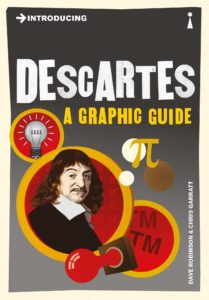
René Descartes is famous as the philosopher who was prepared to doubt everything- even his own physical existence. Most people know that he said ‘I think, therefore I am’, even if they are not always sure what he really meant by it.
Introducing Descartes explains what Descartes doubted, and why he is usually called the father of modern philosophy. It is a clear and accessible guide to all the puzzling questions he asked about human beings and their place in the world. Dave Robinson and Chris Garratt give a lucid account of Descartes’ contributions to modern science, mathematics, and the philosophy of mind- and also reveal why he liked to do all of his serious thinking in bed.
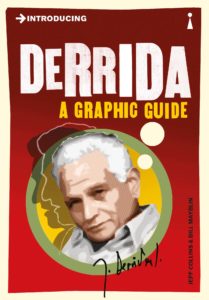
Brilliant illustrated guide to the best-known and most controversial continental philosopher of the latter 20th century. Jacques Derrida is the most famous philosopher of the late 20th century. Yet Derrida has undermined the rules of philosophy, rejected its methods, broken its procedures and contaminated it with literary styles of writing. Derrida’s philosophy is a puzzling array of oblique, deviant and yet rigorous tactics for destabilizing texts, meanings and identities. ‘Deconstruction’, as these strategies have been called, is reviled and celebrated in equal measure. Introducing Derrida introduces and explains his work, taking us on an intellectual adventure that disturbs some of our most comfortable habits of thought.
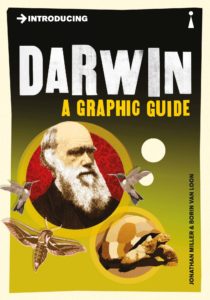
Progress in genetics today would not be possible without Darwin’s revolution, but the mysterious man who laid the rational basis for undermining belief in God’s creation was remarkable timid. He spent most of his life in seclusion; a semi-invalid, riddled with doubts, fearing the controversy his theories might unleash. In this brilliantly lucid book – a classic originally published in 1982 – Jonathan Miller unravels Darwin’s life and his contribution to biology, and traces the path from his scientific predecessors to the later modifications that his own evolutionary theories required. Introducing Darwin brings alive the difficult progress from pre-Darwinian thinking to modern genetics and the devastatingly important impact of one man on our fundamental understanding of biology, life and ourselves.
Cultural Studies signals a major academic revolution for the 21st century. But what exactly is it, and how is it applied? It is a discipline that claims not to be a discipline; it is a radical critical approach for understanding racial, national, social and gender identities. “Introducing Cultural Studies” provides an incisive tour through the minefield of this complex subject, charting its origins in Britain and its migration to the USA, Canada, France, Australia and South Asia, examining the ideas of its leading exponents and providing a flavour of its use around the world. Covering the ground from Gramsci to Raymond Williams, postcolonial discourse to the politics of diaspora, feminism to queer theory, technoculture and the media to globalization, it serves as an insightful guide to the essential concepts of this fascinating area of study. It is essential reading for all those concerned with the quickening pulse of old, new and emerging cultures.