Introducing Lévi-Strauss is a guide to the work of the great French anthropologist Claude Lévi-Strauss (1908–2009). The book brilliantly traces the development and influence of Lévi-Strauss’ thought, from his early work on the function of the incest taboo to initiate an exchange of women between groups, to his identification of a timeless “wild” or “primitive” mode of thinking – a pensée sauvage – behind the processes of human culture. Accessibly written by Boris Wiseman and beautifully illustrated by Judy Groves, Introducing Lévi-Strauss also explores the major contribution that Lévi-Strauss made to contemporary aesthetic history – his work on American-Indian mythology provides a key insight into the way in which art itself comes into being. This is an essential introduction to a key thinker.

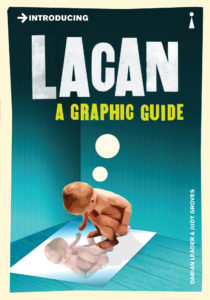
Jacques Lacan is now regarded as a major psychoanalytical theorist alongside Freud and Jung, although recognition has been delayed by fierce arguments over his ideas. Written by a leading Lacanian analyst, “Introducing Lacan” guides the reader through his innovations, including his work on paranoia, his addition of structural linguistics to Freudianism and his ideas on the infant ‘mirror phase’. It also traces Lacan’s influence in postmodern critical thinking on art, literature, philosophy and feminism. This is the ideal introduction for anyone intrigued by Lacan’s ideas but discouraged by the complexity of his writings.
Father of existentialism or the Eeyore of philosophy?
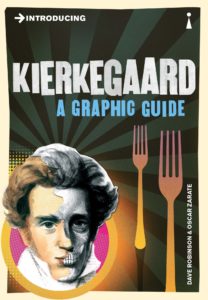
Known as the first modern theologian, Søren Kierkegaard was a prolific writer of the Danish ‘golden age’. A philosopher, poet and social critic, his key concepts of angst, despair, and the importance of the individual, influenced many 20th-century philosophers and literature throughout Europe.
Dave Robinson and Oscar Zarate’s brilliant graphic guide explains what Kierkegaard means by ‘anti-philosophy’, and tells an illuminating story of the strange life and ideas of a man tortured by his attempts to change the very priorities of Western thought.
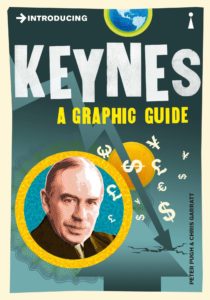
As we find ourselves at the cusp of an economic downturn, there has been a clear reinvigoration of Keynesian economics as governments are attempting to stimulate the market through public funds. Forming his economic theories in the wake of the Great Depression, John Maynard Keynes argued that a healthy economy depended on the total spending of consumers, business investors and, most importantly, governments too. Keynes formulated that governments should take control of the economy in the short term, rather than relying on the market, because, as he eloquently put it ‘in the long run, we are all dead’. This graphic guide is the ideal introduction to one of the most influential economists of the 20th century, at a time when his theories may be crucial to our economic survival. Through a deft mixture of words and images, “Introducing Keynes” is a timely, accessible and enjoyable read.
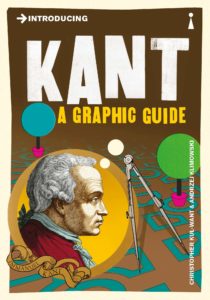
Immanuel Kant laid the foundations of modern Western thought. Every subsequent major philosopher owes a profound debt to Kant’s attempts to delimit human reason as an appropriate object of philosophical enquiry. And yet, Kant’s relentless systematic formalism made him a controversial figure in the history of the philosophy that he helped to shape.
Introducing Kant focuses on the three critiques of Pure Reason, Practical Reason and Judgement. It describes Kant’s main formal concepts: the relation of mind to sensory experience, the question of freedom and the law and, above all, the revaluation of metaphysics. Kant emerges as a diehard rationalist yet also a Romantic, deeply committed to the power of the sublime to transform experience. The illustrated guide explores the paradoxical nature of the pre-eminent philosopher of the Enlightenment, his ideas and explains the reasons for his undiminished importance in contemporary philosophical debates.
‘Clever and witty.’ Susie Orbach, Guardian
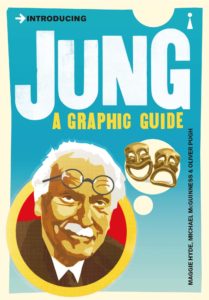
Carl Gustav Jung was the enigmatic and controversial father of analytical psychology.
This updated edition of Introducing Jung brilliantly explains the theories that underpin Jung’s work, delves into the controversies that led him to break away from Freud and describes his near psychotic breakdown, from which he emerged with radical new insights into the nature of the unconscious mind – and which were published for the first time in 2009 in The Red Book.
Step by step, Maggie Hyde demonstrates how it was entirely logical for him to explore the psychology of religion, alchemy, astrology, the I Ching and other phenomena rejected by science in his investigation of his patients’ dreams, fantasies and psychic disturbances.
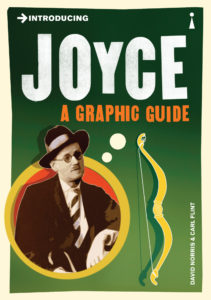
James Joyce is one of the most famous–and controversial–writers of the twentieth century. The myth of his difficulty has discouraged many readers from works such as “Ulysses,” but David Norris explores his life and work in this engaging and intellectually rigorous introduction.
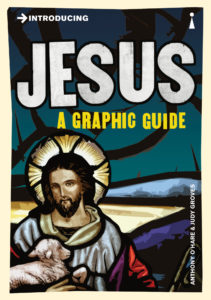
Christianity depends on the belief that the Jesus of history is identical with the Christ of faith, and that God in the person of Jesus intervened finally and decisively in human history. But is the historical Jesus the same as the Christian Saviour? And how did an obscure provincial religion based on the paradox of a crucified saviour conquer the Roman Empire and outlive it? INTRODUCING JESUS – A GRAPHIC GUIDE confronts the enigmas. It sets Jesus in the perspective of his time – within Judaism and its expectations of a Messiah, in the atmosphere of Greek philosophy and the Roman deification of emperors. It traces the development of Christianity from St. Paul and the Romanization of the Church, to modern liberation theology. This book is a lucid and exciting investigation that will appeal to all readers, whether Christian or not.
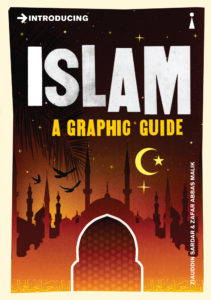
Islam is one of the world’s great monotheistic religions. Islamic culture, spanning 1,500 years, has produced some of the finest achievements of humanity. Yet the religion followed by a fifth of humankind is too often seen in the West in terms of fundamentalism, bigotry and violence- a perception that couldn’t be more wrong.
Introducing Islam recounts the history of Islam from the birth of Prophet Muhammad in the 6th century to its status as a global culture and political force today. Charting the achievements of Muslim civilisation, it explains the nature and message of the Qur’an, outlines the basic features of Islamic law, and assesses the impact of colonialism on Muslim societies.
Ziauddin Sardar and Zafar Abbas Malik show how Muslims everywhere are trying to live their faith and are shaping new Islamic ideas and ideals for a globalised world.
Infinity is a profoundly counter-intuitive and brain-twisting subject that has inspired some great thinkers – and provoked and shocked others. The ancient Greeks were so horrified by the implications of an endless number that they drowned the man who gave away the secret. And a German mathematician was driven mad by the repercussions of his discovery of transfinite numbers.
Brian Clegg and Oliver Pugh’s brilliant graphic tour of infinity features a cast of characters ranging from Archimedes and Pythagoras to al-Khwarizmi, Fibonacci, Galileo, Newton, Leibniz, Cantor, Venn, Gödel and Mandelbrot, and shows how infinity has challenged the finest minds of science and mathematics. Prepare to enter a world of paradox.