Modernism is usually thought of as a shock wave of innovations hitting art, architecture, music, cinema and literature – the work of Picasso, Joyce, Schoenberg, movements like Futurism and Dada, the architecture of Le Corbusier, T.S. Eliot’s The Wasteland and the avant-garde theatre of Bertolt Brecht or Samuel Beckett. But what really defines modernism? Why did it begin and how long did it last? Is Modernism over now? Chris Rodriguez and Chris Garratt’s brilliant graphic guide is a brilliant exploration of the last century’s most thrilling artistic work – and what it’s really all about.

INTRODUCING guide to the pioneering child psychoanalyst. Born in Vienna in 1882, Melanie Klein became a pioneer in child psychoanalysis and developed several ground-breaking concepts about the nature and crucial importance of the early stages of infantile development. Although she was a devoted Freudian, many of her ideas were seen within the psychoanalytic movement as highly controversial, and this led to heated conflicts, particularly with Freud’s daughter, Anna. Introducing Melanie Klein brilliantly explains Klein’s ideas, and shows the importance of her startling discoveries which raised such opposition at the time and are only now being recognized for their explanatory power. Her concepts of the depressive position and the paranoid-schizoid position are now in common usage and her work has to be taken seriously by psychoanalysts the world over. She is also now important in many academic fields within the human sciences.
The media is ubiquitous. Every day we watch hours of TV, listen to the radio, read newspapers and magazines, go to the cinema, sit in front of videos or surf the Web. These information commodities exercise enormous influence and power over all of us. Introducing Media Studies explores the complex relationship between the media, ideology, knowledge and power. It provides a scintillating tour of media history and presents a coherent view of the media industry, media theory and methods in media research. It explains how ‘the audience’ is constructed and how it in turn interprets the content and meaning of media representation. We also learn how to analyse film, deconstruct advertising and appreciate how TV and the press shape public opinion. The media is a condition of our existence and, in an unprecedented way, the pervading shape of our history. No one can afford to neglect a critical understanding of its omnipresence. Here is an entertaining and informative book, accessible to students and general readers concerned with the increasing power, influence and proliferation of the media.
What is mathematics, and why is it such a mystery to so many people?
Mathematics is the greatest creation of human intelligence. It affects us all. We depend on it in our daily lives, and yet many of the tools of mathematics, such as geometry, algebra and trigonometry, are descended from ancient or non-Western civilizations.
Introducing Mathematics traces the story of mathematics from the ancient world to modern times, describing the great discoveries and providing an accessible introduction to such topics as number-systems, geometry and algebra, the calculus, the theory of the infinite, statistical reasoning and chaos theory. It shows how the history of mathematics has seen progress and paradox go hand in hand – and how this is still happening today.
Was Marx himself a ‘Marxist’? Was his visionary promise of socialism betrayed by Marxist dictatorship? Is Marxism inevitably totalitarian? What did Marx really say? “Introducing Marxism” provides a fundamental account of Karl Marx’s original philosophy, its roots in 19th century European ideology, his radical economic and social criticism of capitalism that inspired vast 20th century revolutions. It assesses Marxism’s Russian disciples, Lenin, Trotsky and Stalin who forged a ruthless dogmatic Communism. The book examines the alternative Marxist approaches of Gramsci, the Frankfurt School of critical theory and the structuralist Marxism of Althusser in the 1960s. It marshals postmodern interpretations of Marxism and raises the spectre of ‘post-Marxism’ in Derrida’s confrontation with Fukuyama’s ‘end of history’ doctrine.
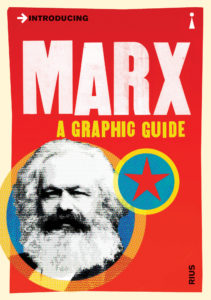
Compact INTRODUCING guide to the influential philosopher, sociologist and economist. INTRODUCING MARX – A GRAPHIC GUIDE explores the life of the most famous Socialist figure, from his early years to meeting Engels in1842. It provides a readable, understandable biography of Karl Marx as well as a fundamental account of his original philosophy, its roots in 19th century European ideology, his radical economic and social criticism of capitalism that inspired vast 20th century revolutions.
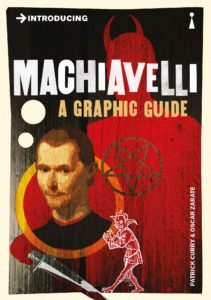
Illustrated guide to the crucial Italian philosopher and author of The Prince. ‘Machiavellian’ is a popular byword for treachery and opportunism. Machiavelli’s classic book on statecraft, The Prince, published over 400 years ago, remains controversial to this day because of its electrifying frankness as a practical guide to power. Is it a how-to manual for dictators, a cynical philosophy of ‘the end justifies the means’, or a more complex and subtle analysis of successful government? Machiavelli was a loyal servant of the Florentine republic. His opposition to Medici despotism led him to torture on the rack and exile, and yet he chose as his model for the Prince the most notorious tyrant, Cesare Borgia. Introducing Machiavelli traces the colourful life of this paradoxical realist whose clear-sighted patriotism made him the first truly modern political scientist. Machiavelli is seen as central to the postmodern debate on Civil Society. This book brings the creative turbulence of Renaissance Italy to life, and presents a compelling portrait of a key figure of European political history.
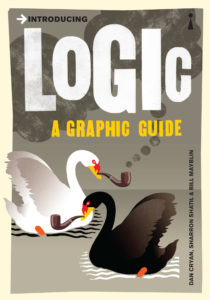
Logic is the backbone of Western civilization, holding together its systems of philosophy, science and law. Yet despite logic’s widely acknowledged importance, it remains an unbroken seal for many, due to its heavy use of jargon and mathematical symbolism.This book follows the historical development of logic, explains the symbols and methods involved and explores the philosophical issues surrounding the topic in an easy-to-follow and friendly manner. It will take you through the influence of logic on scientific method and the various sciences from physics to psychology, and will show you why computers and digital technology are just another case of logic in action.
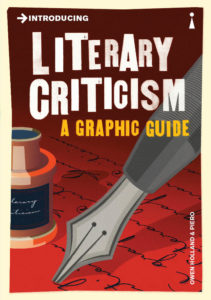
From Plato to Virginia Woolf, Structuralism to Practical Criticism, Introducing Literary Criticism charts the history and development of literary criticism into a rich and complex discipline. Tackling disputes over the value and meaning of literature, and exploring theoretical and practical approaches, this unique illustrated guide will help readers of all levels to get more out of their reading.
Covering thinkers from Aristotle to Saussure and Chomsky, “Introducing Linguistics” reveals the rules and beauty that underlie language, our most human skill.