The ideas of psychoanalysis have permeated Western culture. It is the dominant paradigm through which we understand our emotional lives, and Freud still finds himself an iconic figure. Yet despite the constant stream of anti-Freud literature, little is known about contemporary psychoanalysis.
Introducing Psychoanalysis redresses the balance. It introduces psychoanalysis as a unified ‘theory of the unconscious’ with a variety of different theoretical and therapeutic approaches, explains some of the strange ways in which psychoanalysts think about the mind, and is one of the few books to connect psychoanalysis to everyday life and common understanding of the world.
How do psychoanalysts conceptualize the mind?
Why was Freud so interested in sex?
Is psychoanalysis a science?
How does analysis work?
In answering these questions, this book offers new insights into the nature of psychoanalytic theory and original ways of describing therapeutic practice. The theory comes alive through Oscar Zarate’s insightful and daring illustrations, which enlighten the text. In demystifying and explaining psychoanalysis, this book will be of interest to students, teachers and the general public.

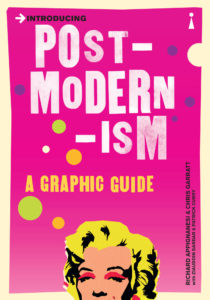
What connects Marliyn Monroe, Disneyworld, "The Satanic Verses" and cyber space? Answer: Postmodernism. But what exactly is postmodernism?
This Graphic Guide explains clearly the maddeningly enigmatic concept that has been used to define the world’s cultural condition over the last three decades.
Introducing Postmodernism tracks the idea back to its roots by taking a tour of some of the most extreme and exhilarating events, people and thought of the last 100 years: in art – constructivism, conceptual art, Marcel Duchamp, Jackson Pollock and Andy Warhol; in politics and history – McCarthy’s witch-hunts, feminism, Francis Fukuyama and the Holocaust; in philosophy – the work of Derrida, Baudrillard, Foucault and Heidegger.The book also explores postmodernism’s take on today, and the anxious grip of globalisation, unpredictable terrorism and unforeseen war that greeted the dawn of the 21st century.
Regularly controversial, rarely straightforward and seldom easy, postmodernism is nonetheless a thrilling intellectual adventure. Introducing Postmodernism is the ideal guide.
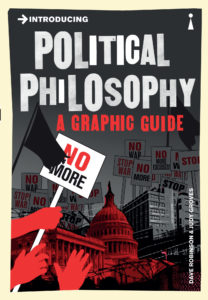
Essential illustrated guide to key ideas of political thought. Philosophers have always asked fundamental and disturbing questions about politics. Plato and Aristotle debated the merits of democracy. The origins of society, the state and government authority were issues addressed by Hobbes, Rousseau, Hegel, Marx and many other philosophers. Introducing Political Philosophy explains the central concepts of this intriguing branch of philosophy and presents the major political theorists from Plato to Foucault. How did governments get started? Why should they be obeyed? Could we live without them? How much power should they have? Is freedom a right? Which is the best form of government? In the wake of consumerism and postmodernism, our need for a better grasp of political ideas is greater than ever. Dave Robinson’s account of this complex subject is always clear, informative and accompanied by the entertainingly inventive illustrations of Judy Groves.
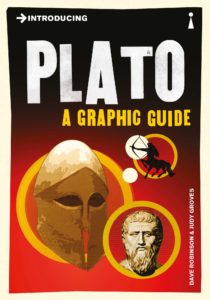
“Introducing Plato” begins by explaining how philosophers like Socrates and Pythagoras influenced Plato’s thought. It provides a clear account of Plato’s puzzling theory of knowledge, and explains how this theory then directed his provocative views on politics, ethics and individual liberty. It offers detailed critical commentaries on all of the key doctrines of Platonism, especially the very odd theory of Forms, and concludes by revealing how Plato’s philosophy stimulated the work of important modern thinkers such as Karl Popper, Martha Nussbaum, and Jacques Derrida.
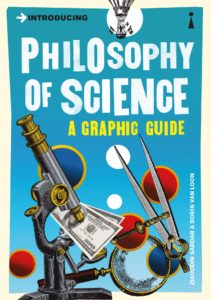
What do scientists actually do? Is science “value-free”? How has science evolved through history? Where is science leading us? “Introducing Philosophy of Science” is a clear and incisively illustrated map of the big questions underpinning science. It is essential reading for students, the general public, and even scientists themselves.
Philosophers have always enjoyed asking awkward and provocative questions, such as:
- What is the nature of reality?
- What are human beings really like?
- What is special about the human mind and consciousness?
- Are we free to choose who we are and what we do?
- Can we prove that God exists?
- Can we be certain about anything at all?
- What is truth?
- Does language provide us with a true picture of the world?
- How should we behave towards each other?
- Do computers think?
Introducing Philosophy is a comprehensive graphic guide to the thinking of all the significant philosophers of the Western world from Heraclitus to Derrida. It examines and explains their key arguments and ideas without being obscure or solemn. Lively and accessible, it is the perfect introduction to philosophers and philosophical ideas for anyone coming to the subject for the first time.
What really happens at the most fundamental levels of nature? Introducing Particle Physics explores the very frontiers of our knowledge, even showing how particle physicists are now using theory and experiment to probe our very concept of what is real. From the earliest history of the atomic theory through to supersymmetry, micro-black holes, dark matter, the Higgs boson, and the possibly mythical graviton, practising physicist and CERN contributor Tom Whyntie gives us a mind-expanding tour of cutting-edge science. Featuring brilliant illustrations from Oliver Pugh, Introducing Particle Physics is a unique tour through the most astonishing and challenging science being undertaken today.
Why must we believe that God is dead? Can we accept that traditional morality is just a ‘useful mistake’? Did the principle of ‘the will to power’ lead to the Holocaust? What are the limitations of scientific knowledge? Is human evolution complete or only beginning? It is difficult to overestimate the importance of Friedrich Nietzsche for our present epoch. His extraordinary insights into human psychology, morality, religion and power seem quite clairvoyant today: existentialism, psychoanalysis, semiotics and postmodernism are plainly anticipated in his writings – which are famously enigmatic and often contradictory.”Introducing Nietzsche” is the perfect guide to this exhilarating and oft-misunderstood philosopher.
“Introducing Newton” explains the extraordinary ideas of a man who sifted through the accumulated knowledge of centuries, tossed out mistaken beliefs, and single-handedly made enormous advances in mathematics, mechanics and optics. By the age of 25, entirely self-taught, he had sketched out a system of the world. Einstein’s theories are unthinkable without Newton’s founding system. He was also a secret heretic, a mystic and an alchemist, the man of whom Edmond Halley said, ‘Nearer to the gods may no man approach!’.
How do emotions affect your basic decision making? Why do certain smells prompt long-forgotten memories, and what makes us suddenly self-conscious?
How does the biological organ, the brain, give rise to all of the thoughts in your head – enable you to think, to feel, to be conscious and aware – to have ‘a mind’?
Introducing Mind and Brain explains what the sciences have to say about planning and action, language, memory, attention, emotions and vision. It traces the historical development of ideas about the brain and its function from antiquity to the age of neuro-imaging.
Clearly explained by Professor of Psychology Angus Gellatly and award-winning artist Oscar Zarate, they invite you to take a fresh look at the nature of mind, consciousness and personal identity.