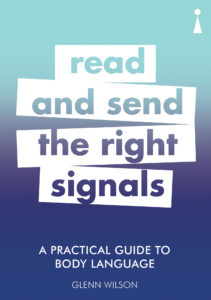
Let your body do the talking.
Whether we’re aware of it, or not, our bodies say a lot about us and how we’re feeling. From interviews to dates, the boardroom to the stage, being aware of the non-verbal signals you, and others, send can have a huge impact on your relationships and success in life – for better or worse.
Full of real-world and pop-cultural examples, practical tips and strategies, and underpinned by principles from psychological and social experiments, you’ll learn how to ‘read’ the body language of others, and how to project the right signals, so you can put your best face,and body, forwards.

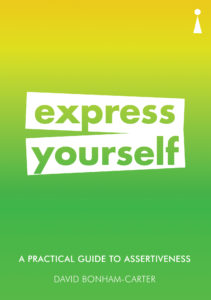
Overcome passive behaviour and take ownership of your thoughts and feelings.
Express yourself more clearly and learn to beat negative thinking, stand up for yourself and feel confident.
Discover the courage to voice your own feelings and thoughts when, even about difficult issues, and to do so in a way which is respectful and honest to others.
In seven straightforward steps, this Practical Guide will help you to develop the key characteristics of assertiveness, helping you to stand up for and be truer to yourself.
LONGLISTED FOR THE WILLIAM HILL SPORTS BOOK OF THE YEAR 2015
Forced to flee his native Bangladesh, eight year-old chess prodigy Fahim arrived in Paris with his father. Refused asylum, as illegal immigrants they spiralled downwards into homelessness and desperation.
By a stroke of luck, Fahim was introduced to one of France’s top chess coaches, Xavier Parmentier, who tutored him and gave him a sense of purpose, his struggles on the chessboard mirroring both his victories and his crushing defeats in his battle for a normal life.
Rising through local and national tournaments to be crowned France’s Under-12 Chess Champion in 2012, Fahim became a national sensation. In 2013 he went on to win the World Under-13 Student Championship.
Told through the clear eyes of a child, Fahim’s tale is not only a moving account of the grim realities that underlie a supposedly caring society, but also a heartwarming testimony to a father’s determination, the kindness of strangers, and one small boy’s courageous will to succeed.
LONGLISTED FOR THE WILLIAM HILL SPORTS BOOK OF THE YEAR 2015
Forced to flee his native Bangladesh, eight year-old chess prodigy Fahim arrived in Paris with his father. Refused asylum, as illegal immigrants they spiralled downwards into homelessness and desperation.
By a stroke of luck, Fahim was introduced to one of France’s top chess coaches, Xavier Parmentier, who tutored him and gave him a sense of purpose, his struggles on the chessboard mirroring both his victories and his crushing defeats in his battle for a normal life.
Rising through local and national tournaments to be crowned France’s Under-12 Chess Champion in 2012, Fahim became a national sensation. In 2013 he went on to win the World Under-13 Student Championship.
Told through the clear eyes of a child, Fahim’s tale is not only a moving account of the grim realities that underlie a supposedly caring society, but also a heartwarming testimony to a father’s determination, the kindness of strangers, and one small boy’s courageous will to succeed.
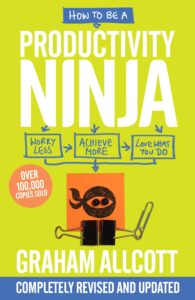
World-leading productivity expert Graham Allcott’s business bible is given a complete update for 2019.
Do you waste too much time on your phone? Scroll through Twitter or Instagram when you should be getting down to your real tasks? Is your attention easily distracted? We’ve got the solution: The Way of the Productivity Ninja.
In the age of information overload, traditional time management techniques simply don’t cut it anymore. Using techniques including Ruthlessness, Mindfulness, Zen-like Calm and Stealth & Camouflage, this fully revised new edition of How to be a Productivity Ninja offers a fun and accessible guide to working smarter, getting more done and learning to love what you do again.
As end-of-the-world scenarios go, an apocalyptic collision with an asteroid or comet is the new kid on the block, gaining respectability only in the last decade of the 20th century with the realisation that the dinosaurs had been wiped out by just such an impact.
Now the science community is making up for lost time, with worldwide efforts to track the thousands of potentially hazardous near-Earth objects, and plans for high-tech hardware that could deflect an incoming object from a collision course – a procedure depicted, with little regard for scientific accuracy, in several Hollywood movies.
Astrophysicist and science writer Andrew May disentangles fact from fiction in this fast-moving and entertaining account, covering the nature and history of comets and asteroids, the reason why some orbits are more hazardous than others, the devastating local and global effects that an impact event would produce, and – more optimistically – the way future space missions could avert a catastrophe.
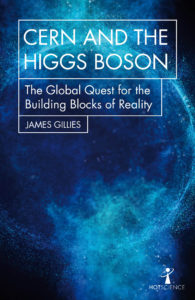
The Higgs boson is the rock star of fundamental particles, catapulting CERN, the laboratory where it was found, into the global spotlight. But what is it, why does it matter, and what exactly is CERN?
In the late 1940s, a handful of visionaries were working to steer Europe towards a more peaceful future through science, and CERN, the European particle physics laboratory, was duly born. James Gillies tells the gripping story of particle physics, from the original atomists of ancient Greece, through the people who made the crucial breakthroughs, to CERN itself, one of the most ambitious scientific undertakings of our time, and its eventual confirmation of the Higgs boson.
Weaving together the scientific and political stories of CERN’s development, the book reveals how particle physics has evolved from being the realm of solitary genius to a global field of human endeavour, with CERN’s Large Hadron Collider as its frontier research tool.
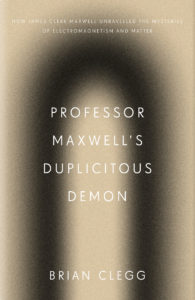
Asked to name a great physicist, most people would mention Newton or Einstein, Feynman or Hawking. But ask a physicist and there’s no doubt that James Clerk Maxwell will be near the top of the list. Maxwell, an unassuming Victorian Scotsman, explained how we perceive colour. He uncovered the way gases behave. And, most significantly, he transformed the way physics was undertaken in his explanation of the interaction of electricity and magnetism, revealing the nature of light and laying the groundwork for everything from Einstein’s special relativity to modern electronics. Along the way, he set up one of the most enduring challenges in physics, one that has taxed the best minds ever since. ‘Maxwell’s demon’ is a tiny but thoroughly disruptive thought experiment that suggests the second law of thermodynamics, the law that governs the flow of time itself, can be broken. This is the story of a groundbreaking scientist, a great contributor to our understanding of the way the world works, and his duplicitous demon.
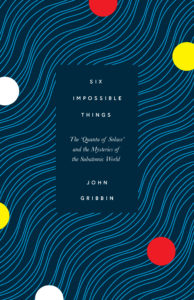
Quantum physics is strange. It tells us that a particle can be in two places at once. Indeed, that particle is also a wave, and everything in the quantum world can be described entirely in terms of waves, or entirely in terms of particles, whichever you prefer.
All of this was clear by the end of the 1920s. But to the great distress of many physicists, let alone ordinary mortals, nobody has ever been able to come up with a common sense explanation of what is going on. Physicists have sought ‘quanta of solace’ in a variety of more or less convincing interpretations. Popular science master John Gribbin takes us on a delightfully mind-bending tour through the ‘big six’, from the Copenhagen interpretation via the pilot wave and many worlds approaches.
All of them are crazy, and some are more crazy than others, but in this world crazy does not necessarily mean wrong, and being more crazy does not necessarily mean more wrong.
World-leading productivity expert Graham Allcott’s business bible is given a complete update for 2019.
Do you waste too much time on your phone? Scroll through Twitter or Instagram when you should be getting down to your real tasks? Is your attention easily distracted? We’ve got the solution: The Way of the Productivity Ninja.
In the age of information overload, traditional time management techniques simply don’t cut it anymore. Using techniques including Ruthlessness, Mindfulness, Zen-like Calm and Stealth & Camouflage, this fully revised new edition of How to be a Productivity Ninja offers a fun and accessible guide to working smarter, getting more done and learning to love what you do again.