Shakespeare’s absolute pre-eminence is simply unparalleled. His plays pack theatres and provide Hollywood with block-buster scripts; his works inspire mountains of scholarship and criticism every year. He has given us many of the very words we speak, and even some of the thoughts we think.
Nick Groom and Piero explore how Shakespeare became so famous and influential, and why he is still widely considered the greatest writer ever. They investigate how the Bard has been worshiped at different times and in different places, used and abused to cultural and political ends, and the roots of intense controversies which have surrounded his work.
Much more than a biography or a guide to his plays and sonnets, Introducing Shakespeare is a tour through the world of Will and concludes that even after centuries, Shakespeare remains the battlefield on which our very comprehension of humanity is being fought out.

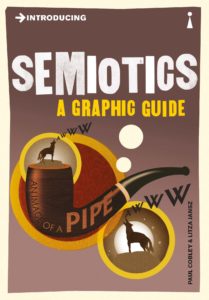
“Introducing Semiotics” outlines the development of sign study from its classical precursors to contemporary post-structuralism. Through Paul Cobley’s incisive text and Litza Jansz’s brilliant illustrations, it identifies the key semioticians and their work and explains the simple concepts behind difficult terms. For anybody who wishes to know why signs are crucial to human existence and how we can begin to study systems of signification, this book is the place to start.
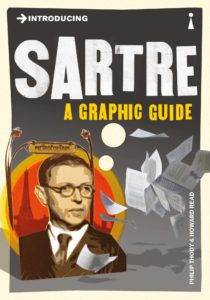
INTRODUCING guide to the father of existentialism and one of 20th century philosophy’s most famous characters. Jean-Paul Sartre was once described as being, next to Charles de Gaulle, the most famous Frenchman of the 20th century. Between the ending of the Second World War in 1945 and his death in 1980, Sartre was certainly the most famous French writer, as well as one of the best-known living philosophers. Introducing Sartre explains the basic ideas inspiring his world view, and pays particular attention to his idea of freedom. It also places his thinking on literature in the context of the 20th century debate on its nature and function. It examines his ideas on Marxism, his enthusiasm for the student rebellion of 1968, and his support for movements of national liberation in the Third World. The book also provides a succinct account of his life, and especially of the impact which his unusual childhood had on his attitude towards French society.
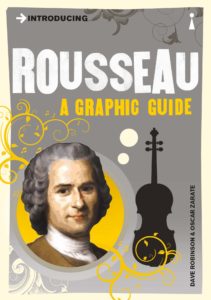
Illustrated guide to the crucial French philosopher who denied bring a philosopher at all. ‘I am like no one else in the whole world …’ Thus begins Jean-Jacques Rousseau’s defiant Confessions – an autobiography of astounding psychological insight. Musician, poet, novelist and botanist, but above all, a philosopher who firmly denied being one, Rousseau was the first to ask: “What is the value of civilization?” His answer – that civilization corrupts natural goodness and increases social inequalities – shocked his Enlightenment contemporaries and still challenges us today. Did Rousseau inspire the French Revolution? Can Romanticism, psychoanalysis and Existentialism all be traced back to him? Introducing Rousseau presents a maverick thinker whose ideas revolutionized our understanding of childhood, education, government, language and much else. Dave Robinson’s clear and concise account of Rousseau’s ideas, engagingly dramatized by Oscar Zarate’s illustrations, guides the reader through Rousseau’s turbulent life of lost innocence, persecution and paranoia.
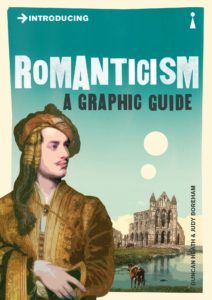
Philosophy, art, literature, music, and politics were all transformed in the turbulent period between the French Revolution of 1789 and the Communist Manifesto of 1848.
This was the age of the ‘Romantic revolution’, when modern attitudes to political and artistic freedom were born. When we think of Romanticism, flamboyant figures such as Byron or Shelley instantly spring to mind, but what about Napoleon or Hegel, Turner or Blake, Wagner or Marx?
How was it that Romanticism could give birth to passionate individualism and chauvinistic nationalism at the same time? How did it prefigure the totalitarian movements of the 20th century?
Duncan Heath and Judy Boreham answer these questions and provide a unique overview of the many interlocking strands of Romanticism, focusing on the leading figures in Britain, Germany, France, Italy, Russia and America.
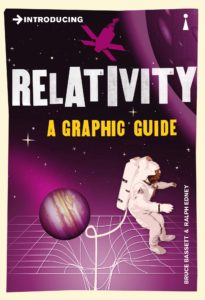
A superlative, fascinating graphic account of Albert Einstein’s strange world and how his legacy has been built upon since.
It is now more than a century since Einstein’s theories of Special and General Relativity began to revolutionise our view of the universe. Beginning near the speed of light and proceeding to explorations of space-time and curved spaces, Introducing Relativity plots a visually accessible course through the thought experiments that have given shape to contemporary physics.
Scientists from Isaac Newton to Stephen Hawking add their unique contributions to this story, as we encounter Einstein’s astounding vision of gravity as the curvature of space-time and arrive at the breathtakingly beautiful field equations. Einstein’s legacy is reviewed in the most advanced frontiers of physics today – black holes, gravitational waves, the accelerating universe and string theory.
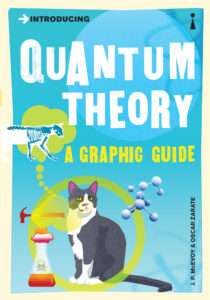
Quantum theory confronts us with bizarre paradoxes which contradict the logic of classical physics.
At the subatomic level, one particle seems to know what the others are doing, and according to Heisenberg’s "uncertainty principle", there is a limit on how accurately nature can be observed. And yet the theory is amazingly accurate and widely applied, explaining all of chemistry and most of physics.
Introducing Quantum Theory takes us on a step-by-step tour with the key figures, including Planck, Einstein, Bohr, Heisenberg and Schrodinger. Each contributed at least one crucial concept to the theory. The puzzle of the wave-particle duality is here, along with descriptions of the two questions raised against Bohr’s "Copenhagen Interpretation" – the famous "dead and alive cat" and the EPR paradox. Both remain unresolved.
An INTRODUCING PRACTICAL GUIDE to getting what you want in life. Occupational Psychologist Alison Price explores both how successful people think, and how the organizations in which they work foster a culture of success, in this easy-to-read and jargon-free INTRODUCING PRACTICAL GUIDE. With numerous real-life case studies, practical strategies to implement and easy-to-remember points to remember and work towards, this book could be your first step on the road to a more successful life.
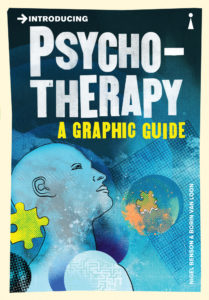
What is psychotherapy? How can we choose wisely from so much on offer?
This book provides a valuable summary of the main therapies: the “talking cures” of psychoanalysis, behavioral and cognitive techniques, somatic solutions, humanist gestalt and existential approaches, and individual and group therapies.
What is psychology? When did it begin? Where did it come from? How does psychology compare with related subjects such as psychiatry and psychotherapy? To what extent is it scientific?
Introducing Psychology answers all these questions and more, explaining what the subject has been in the past and what it is now. The main "schools" of thought and the sections within psychology are described, including Introspection, Biopsychology, Psychoanalysis, Behaviourism, Comparative (Animal) Psychology, Cognitive Approaches (including the Gestalt movement), Social Psychology, Developmental Psychology and Humanism. The key figures covered include: Freud, Pavlov, Skinner, Bandura, Piaget, Bowlby, Maslow and Rogers, as well as many lesser-known but important psychologists.