Islam is one of the world’s great monotheistic religions. Islamic culture, spanning 1,500 years, has produced some of the finest achievements of humanity. Yet the religion followed by a fifth of humankind is too often seen in the West in terms of fundamentalism, bigotry and violence- a perception that couldn’t be more wrong.
Introducing Islam recounts the history of Islam from the birth of Prophet Muhammad in the 6th century to its status as a global culture and political force today. Charting the achievements of Muslim civilisation, it explains the nature and message of the Qur’an, outlines the basic features of Islamic law, and assesses the impact of colonialism on Muslim societies.
Ziauddin Sardar and Zafar Abbas Malik show how Muslims everywhere are trying to live their faith and are shaping new Islamic ideas and ideals for a globalised world.

Why do Hindus revere the cow?
Must Hindus be vegetarian?
Hinduism is the world’s oldest religion, yet the word ‘Hindu’ was never used before the 18th century by Hindus to describe themselves. it is defined as polytheistic, but Gandhi declared that a Hindu needn’t believe in any god. it is a religion as much of myth as of history – it has no founder, no single authoritative book, even few central doctrines.
Introducing Hinduism offers a guide to the key philosophical, literary, mythological and cultural traditions of the extraordinarily diverse faith. It untangles the complexities of Hinduism’s gods and goddesses, its caste system and its views on sex, everyday life and asceticism.
Vinay Lal and Borin Van Loon’s hugely enjoyable tour through Hinduism also explores its links with and differences from Buddhism, Jainism and other religions, the resurgence of Hindu extremism, the phenomenon of Bollywood and the overseas Hindu diaspora.
Martin Heidegger – philosophy’s ‘hidden king’, or leading exponent of a dangerously misguided secular mysticism. Heidegger has been acclaimed as the most powerfully original philosopher of the twentieth century. Profoundly influential on deconstruction, existentialism and phenomenology, he stands behind all major strands of post-structuralist and postmodern thought. Heidegger announced the end of philosophy and of humanism, and was a committed Nazi and vocal supporter of Hitler’s National Socialism. Was Heidegger offering a deeply conservative mythology or a crucial deconstruction of philosophy as we have known it? “Introducing Heidegger” provides an accessible introduction to his notoriously abstruse thinking, mapping out its historical contexts and exploring its resonances in ecology, theology, art, architecture, literature and other fields. The book opens up an encounter with a kind of thinking whose outlines might still not yet be clear, and whose forms might still surprise us.
INTRODUCING guide to the hugely influential German thinker. Georg Wilhelm Friedrich Hegel is one of the greatest thinkers of all time. No other philosopher has had such a profound impact on the ideas and political events of the 20th century. Hegel’s influential writings on philosophy, politics, history and art are parts of a larger systematic whole. They are also among the most difficult in the entire literature of philosophy. Introducing Hegel guides us through a spectacular system of thought which aimed to make sense of history. The book also provides new perspectives on contemporary postmodern debates about ‘metanarratives’ (Lyotard) and the ‘end of history’ (Fukuyama). It is an ideal introduction to this crucial figure in the history of philosophy, and is indispensable for anyone trying to understand such key modern thinkers as Marx, Lacan, Satre and Adorno.
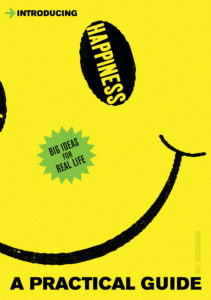
Apply the wisdom of philosophers to become a happier person.
What is happiness? What makes you happy?Is there more to life than happiness?
Learn to cultivate your taste for pleasure, free yourself from the various disturbances of life, and overcome irrational expectations that cause distress. Go with the flow and rediscover the joy of existence.
Filled with exercises, tips and case studies, this Practical Guide will enable you to see happiness in a new light, with the help of the world’s greatest minds
Using comic-book style illustration combined with accessible but authoritative text, the Introducing Graphic Guide series is a uniquely brilliant way to get your head around some of humankind’s most thrilling ideas. In Introducing Existentialism: A Graphic Guide, Richard Appignanesi goes on a personal quest of Existentialism in its original state. He begins with Camus’ question of suicide: ‘Must life have a meaning to be lived?’ Is absurdity at the heart of Existentialism? Or is Sartre right: is Existentialism ‘the least scandalous, most technically austere’ of all teachings? Introducing Sartre: A Graphic Guide explains the basic ideas inspiring his world view, and pays particular attention to his idea of freedom. It also places his thinking on literature in the context of the 20th century debate on its nature and function. It examines his ideas on Marxism, his enthusiasm for the student rebellion of 1968, and his support for movements of national liberation in the Third World. This Graphic Guide also provides a succinct account of his life, and especially of the impact which his unusual childhood had on his attitude towards French society. Introducing Camus: A Graphic Guide portrays a man who was an intellectual in the tradition of the great French humanists, a Resistance fighter during World War II, and also a great sensualist for whom sun, sea, sex, football, and theater were the answer to life’s absurdity.
What is the place of individual choice and consequence in a post-Holocaust world of continuing genocidal ethnic cleansing? Is ‘identity’ now a last-ditch cultural defence of ethnic nationalisms and competing fundamentalisms? In a climate of instant information, free markets and possible ecological disaster, how do we define ‘rights’, self-interest and civic duties? Introducing Ethics confronts these dilemmas, tracing the arguments of the great moral thinkers, including Socrates, Plato, Aristotle, Hobbes and Kant, and brings us up to date with postmodern critics. Logic is the backbone of Western civilization, holding together its systems of philosophy, science and law. Yet despite logic’s widely acknowledged importance, it remains an unbroken seal for many, due to its heavy use of jargon and mathematical symbolism. Introducing Logic follows the historical development of logic, explains the symbols and methods involved and explores the philosophical issues surrounding the topic. It will take you through the influence of logic on scientific method and the various sciences from physics to psychology, and will show you why computers and digital technology are just another case of logic in action. Dave Robinson and Judy Groves’ Introducing Philosophy explores the awkward and provocative questions that philosophers have always enjoyed asking, such as: what is the nature of reality? Can we prove that God exists? Does language provide us with a true picture of the world? Comprehensive and enjoyable, it examines the key arguments and ideas off all the significant philosophers of the Western world from Heraclitus to Derrida.
Using comic-book style illustration combined with accessible but authoritative text, the Introducing Graphic Guide series is a uniquely brilliant way to get your head around some of humankind’s most thrilling ideas. In 1859, Charles Darwin shocked the world with a radical theory – evolution by natural selection. One hundred and fifty years later, his theory still challenges some of our most precious beliefs. Introducing Evolution: A Graphic Guide, on ‘Darwin’s dangerous idea’, takes a fresh look at the often misunderstood concepts of natural selection and the selfish gene. Introducing Darwin: A Graphic Guide the difficult progress from pre-Darwinian thinking to modern genetics, and the devastatingly important impact of one man on our fundamental understanding of biology, life and ourselves. Introducing Genetics: A Graphic Guide takes readers on a journey through this new science to the discovery of DNA and the heart of the human gene map. In everyday life, many of us increasingly have to make moral decisions where genetics plays a part. This Graphic Guide gives us the information to do so.
Using comic-book style illustration combined with accessible but authoritative text, the Introducing Graphic Guide series is a uniquely brilliant way to get your head around some of humankind’s most thrilling ideas. Infinity is a profoundly counter-intuitive and brain-twisting subject that has inspired some great thinkers – and provoked and shocked others. Introducing Infinity: A Graphic Guide is a brilliant graphic tour of infinity features a cast of characters ranging from Archimedes and Pythagoras to al-Khwarizmi, Fibonacci, Galileo, Newton, Leibniz, Cantor, Venn, Gödel and Mandelbrot, and shows how infinity has challenged the finest minds of science and mathematics. Introducing Consciousness presents the history of the philosophical relation between mind and matter, and covers the scientific attempts to explain consciousness in terms of neural mechanisms, cerebral computation and quantum mechanics. It also introduces readers to zombies, ghosts in machines and Schrodinger’s cat. Stephen Hawking is the world-famous physicist; to the public he is a tragic figure – a brilliant scientist and author of the 9 million-copy-selling ‘A Brief History of Time’, and yet confined to a wheelchair and almost completely paralysed. Introducing Stephen Hawking: A Graphic Guide guide explores his life, and the evolution of his work from his days as a student.
Using comic-book style illustration combined with accessible but authoritative text, the Introducing Graphic Guide series is a uniquely brilliant way to get your head around some of humankind’s most thrilling ideas. What really happens at the most fundamental levels of nature? Introducing Particle Physics: A Graphic Guide explores the very frontiers of our knowledge, even showing how particle physicists are now using theory and experiment to probe our very concept of what is real. What makes philosophy on the continent of Europe so different and exciting? And why does it have such a reputation for being ‘difficult’? Covering the great philosophers of the modern and postmodern eras – from Nietzsche, Heidegger, Derrida and Deleuze right to up Agamben and Žižek – and philosophical movements from German idealism to deconstruction and feminism – Introducing Continental Philosophy: A Graphic Guide brilliantly elucidates some of the most thrilling and powerful ideas ever to have been discussed. Covering topics from philosophy and ethics, politics and ideology, religion and art, to literature, cinema, corporate marketing, quantum physics and virtual reality, Introducing Slavoj Zizek: A Graphic Guide deftly explains Zizek’s virtuoso ability to transform apparently outworn ideologies – Communism, Marxism and psychoanalysis – into a new theory of freedom and enjoyment.